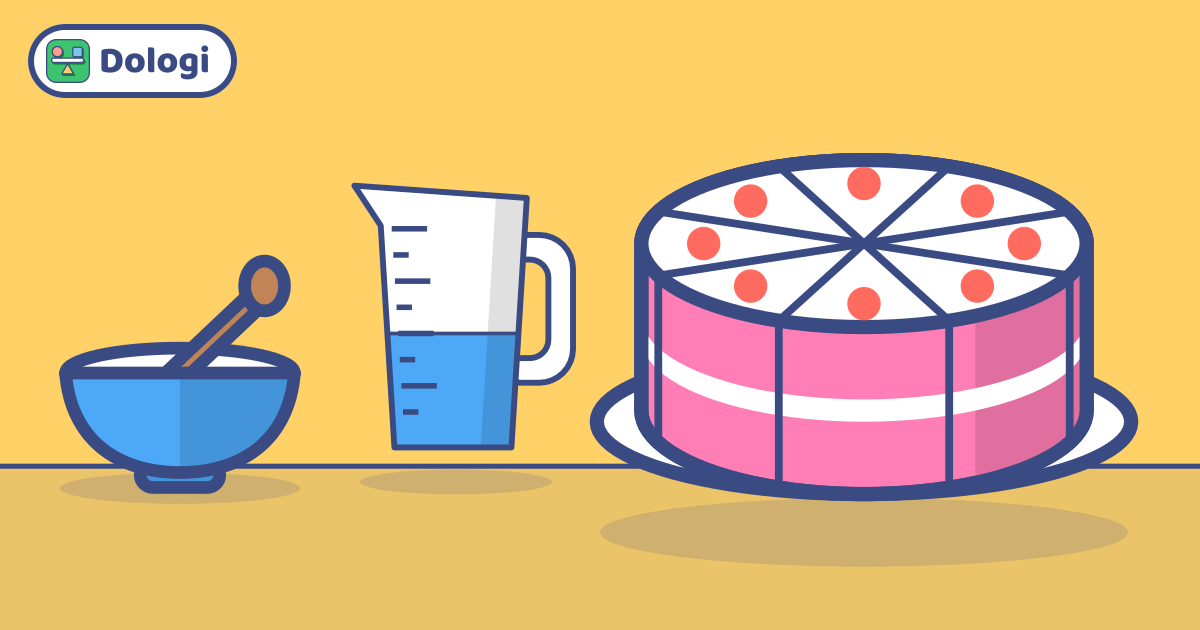
Ask your child "what's half of three quarters?" on paper and you may get a blank stare. But when they're holding a measuring cup and you say "we're only making half the recipe today," they'll find a way. The kitchen gives kids a real reason to count, measure, multiply, and divide, and the results are edible. Here are some small math jobs your child can do while helping you cook, from easiest to hardest.
Measuring with cups and spoons: counting scoops
The first job is simply counting scoops. If the recipe says "3 tablespoons of sugar," your child scoops three times, leveling each one off. Count out loud, keep track on fingers, then check together.
A few questions to explore:
- "How many small cups of water fill this bowl?" Your child pours and counts. Switch to a bigger cup: more pours or fewer?
- "How many teaspoons make a tablespoon?" Fill the tablespoon with a teaspoon: it's full after 3.
- "How many quarter cups make one cup?" 4. And a quarter cup is the same as 4 tablespoons, so a full cup is 16 tablespoons.
That's what measuring really is: pick a unit and count how many you need. Reading the lines on a measuring cup has its own post, linked at the end.
Doubling and halving a recipe
Pick a family favorite, like pancakes. A recipe that makes about 8 might be:
| Ingredient | About 8 pancakes | Double (about 16) | Half (about 4) |
|---|---|---|---|
| Flour | 1 cup | 2 cups | ½ cup |
| Sugar | 2 tablespoons | 4 tablespoons (¼ cup) | 1 tablespoon |
| Egg | 1 | 2 | ½ |
| Milk | ¾ cup | 1½ cups | ⅜ cup (6 tablespoons) |
| Melted butter | 2 tablespoons | 4 tablespoons | 1 tablespoon |
Have your child fill in the "double" column first: multiply everything by 2. Then "half": divide everything by 2.
Half of ¾ cup is the fun one. There's no ⅜ cup scoop, so how do you measure it? Since ¼ cup is 4 tablespoons, ¾ cup is 12 tablespoons, and half of that is 6 tablespoons.
The half egg is where math meets real life. Ask: "We can't cut an egg in half, so what do we do?" You can beat the egg and use about half of it, or just use a whole egg and accept slightly different pancakes. There's no single right answer; what matters is understanding why you have to choose.
A common mistake: "Two more people are coming, so add two more eggs." The better way to think is in portions: how much does each person need, then multiply. That's an early step toward ratios, which comes back later in school.
What doesn't double
This part is interesting because kids have to think, not just calculate.
- Cooking time. Twice as much batter means twice as many pancakes, not pancakes that cook twice as long. Each one still takes about the same time on the griddle.
- Oven temperature. Nobody bakes cookies at double the temperature.
- Pan size. Double a cake recipe but use the same pan, and the cake will be twice as thick and may overflow.
- Salt and spices. Scale them, then taste, because seasoning follows taste more than arithmetic.
Ask: "What in this meal can we double, and what can't we?" It builds the habit of checking whether a calculation makes sense in the real world.
Cutting a cake into equal pieces
A round birthday cake is the friendliest fraction lesson there is. A grown-up does the cutting; your child shows where to cut:
- One cut through the middle: 2 equal pieces, each one half.
- A second cut across the first: 4 pieces, each one a quarter.
- Two more diagonal cuts: 8 pieces, each one an eighth.
Ask: "Are two eighths the same as one quarter?" Lay two small pieces on top of a big one to compare: they match. And: "The cake has 8 pieces and there are 3 of us. How many does each person get?" Two each, with 2 left over.
A rectangular sheet cake turns into multiplication: 4 rows of 5 squares is 4 × 5 = 20 pieces. A pan of brownies works just as well.
Ideas by age, and safety
- Ages 4–6: count spoonfuls and eggs, pour water from a small cup into a bowl, compare which cup holds more.
- Ages 7–9: read the recipe, measure each ingredient, double and halve with easy numbers, cut cake into halves, quarters, and eighths.
- Ages 10–12: make 1½ times a recipe, convert cups to tablespoons, and plan the timing (if the slowest dish takes 45 minutes and dinner is at 6:30, start by 5:45).
On safety: grown-ups handle knives, the stove, the oven, and anything hot. Kids measure, count, stir in the mixing bowl, arrange food, and point to where the cuts go. Agree on your child's jobs before you start.
In the Math topic in Dologi there's a puzzle called Fill the jug: your child looks at the marks on a jug and on a cup, then works out how many more full cups it takes to fill the jug to the top. That's exactly the scoop-counting kids do in the kitchen.
In short
- Measuring means counting units: how many spoonfuls, how many cups; 3 teaspoons make a tablespoon and 16 tablespoons make a cup.
- Doubling or halving a recipe means multiplying or dividing every ingredient.
- Cooking time, oven temperature, pan size, and seasoning don't simply scale; the math has to fit real life.
- Cutting a round cake into 2, 4, and 8 pieces makes fractions visible; a sheet cake turns into multiplication.
Read more: Reading the marks on a ruler, a scale and a measuring cup: how much is each line worth?, Teaching fractions to children: start by sharing a cake, Which lemonade is sourer, which pack is cheaper? Comparing ratios for 9 to 12 year olds