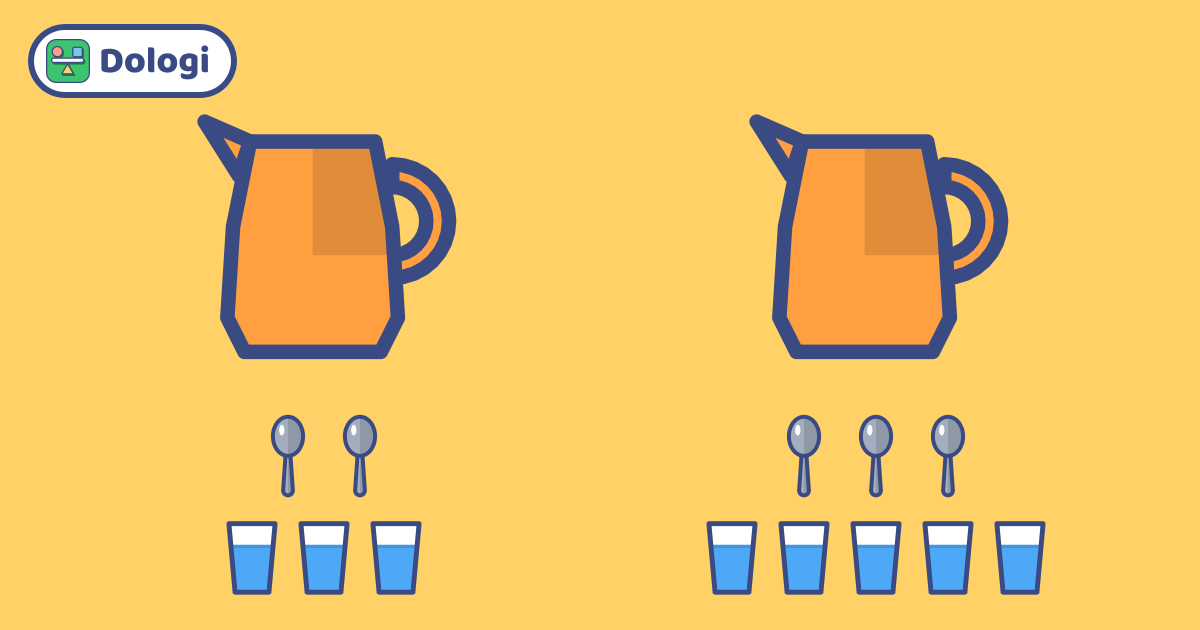
Two jugs of lemonade: jug A is 2 spoons of lemon juice to 3 cups of water, jug B is 3 spoons to 5 cups. Ask a 9 to 12 year old which is sourer and most will pick B "because it has 3 spoons, more lemon". But B also has more water. This question opens the door to a big idea: comparing ratios, which means asking how much lemon each cup of water gets, not counting spoons.
Guess, then taste
Actually mix both jugs (add the same amount of sugar per cup if you like), but before tasting, have your child guess and explain why. Then taste. Most kids are surprised: jug A is sourer, even though it has less lemon.
Why? Share it out: in jug A, each cup of water gets 2/3 of a spoon of lemon, about 0.67. In jug B, each cup gets only 3/5 of a spoon, which is 0.6. Every cup in A gets a little more lemon.
Scale up to the same amount of water
Dividing into fractions is hard at 9. An easier way is to scale the recipes up until both jugs have the same number of cups of water:
| Recipe A | Recipe B |
|---|---|
| 2 spoons : 3 cups | 3 spoons : 5 cups |
| 4 spoons : 6 cups | 6 spoons : 10 cups |
| 6 spoons : 9 cups | 9 spoons : 15 cups |
| 8 spoons : 12 cups | |
| 10 spoons : 15 cups |
With 15 cups of water, A needs 10 spoons of lemon and B only 9. So A is sourer. Your child can also match the spoons instead: with 6 spoons, A makes 9 cups and B makes 10. B is weaker.
Doubling or tripling a recipe doesn't change the taste: 4 spoons to 6 cups tastes exactly like 2 spoons to 3 cups. Let your child mix a small jug and a big jug in the same ratio and taste: no difference.
The "difference" trap
Some kids reason: "A has 1 more cup of water than spoons of lemon, B has 2 more, so B is weaker." That works this time, but only by luck. Try 2 spoons : 3 cups against 4 spoons : 6 cups. The differences are 1 and 2, yet the two jugs taste exactly the same. Comparing ratios uses multiplying and dividing, not subtracting.
At the store: which pack is cheaper?
The same thinking works when shopping. A 12-ounce bag of crackers costs $3, and a 30-ounce bag costs $6. Which is the better deal?
Bring both to the same amount, say 60 ounces, with a multiplying table:
| Small bag | Big bag |
|---|---|
| 12 oz: $3 | 30 oz: $6 |
| 24 oz: $6 | 60 oz: $12 |
| 36 oz: $9 | |
| 48 oz: $12 | |
| 60 oz: $15 |
For 60 ounces, small bags cost $15 and big bags $12: the big bag is cheaper. Per ounce it is the same story: 25 cents against 20 cents.
But bigger isn't always cheaper. A 3-pack of juice boxes costs $2.10, and a 4-pack costs $3.00. Per box that is $0.70 against $0.75, so the smaller pack is cheaper per box. To avoid dividing, bring both to 12 boxes: four 3-packs cost $8.40, three 4-packs cost $9.00.
And cheaper isn't always better: if the big bag goes stale before you finish it, the small one wins. That is a good question to talk over together.
Games at home and at the store
- Price detective: at the store, give your child two sizes of the same product and let them work out which is cheaper for the same amount. Many shelf labels also show a unit price (per ounce or per pound); your child works it out first, then checks.
- Color mixing: mix colored water with "2 drops of red to 3 spoons of water" and "3 drops to 5 spoons", guess which is darker, then look.
- Scaling recipes: when you cook, ask your child to work out the ingredients for a double or triple batch.
Common mix-ups
| Your child thinks | Actually | How to help |
|---|---|---|
| 3 spoons is more than 2, so B is sourer | Compare lemon for the same amount of water | Scale both to 15 cups |
| A smaller difference means stronger | 2 : 3 and 4 : 6 have different differences but taste the same | Compare by multiplying and dividing |
| The big pack is always cheaper | The 3-pack can be cheaper per box | Price the same amount |
| A double batch is twice as sour | Doubling lemon and water keeps the taste | Taste a small and a big jug |
How ratios are written
In English, a recipe like "2 spoons to 3 cups" is written as the ratio 2 : 3 and read "two to three". Prices use a decimal point ($2.10), and unit prices in the US are often given in cents per ounce. Ratios and unit rates usually become a formal topic in the last years of elementary school or the start of middle school, and a jug of lemonade is the easiest way to make them mean something.
The Math topic in Dologi has a puzzle called Compare the baskets: "Both sides of the trade card are worth the same. Which basket is worth more?" Its hint says "Trade all the fruit for the kind worth the least, so none is left over": the same idea of bringing everything to one unit before comparing, just like scaling both jugs to 15 cups of water.
In short
- Comparing ratios means comparing amounts for the same share, not raw counts.
- Scale the recipes up until they use the same amount of water (or the same spoons), then compare.
- Doubling or tripling both ingredients keeps the taste the same.
- At the store, compare the price of the same amount; the big pack isn't always cheaper.
Read next: Unit rate problems: find the price of one first, Equivalent fractions and comparing fractions, Percentages for 10 to 12 year olds