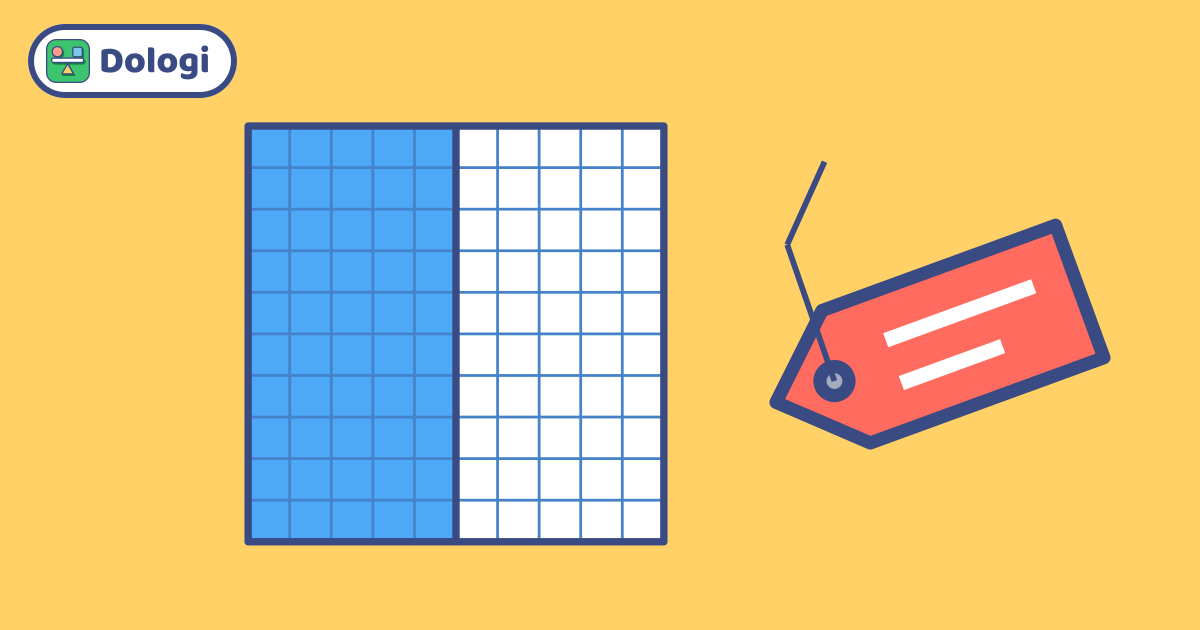
Battery at 50%, a jacket at "30% off", a cereal box with "20% extra free": 10 to 12 year olds meet percentages every day, yet many still treat the % sign as a strange code. A percentage is really just a very familiar kind of fraction: parts out of a hundred. This post goes from a hundred-square grid, through a cake, to the sale rack.
Percent means "out of a hundred"
Draw a 10 × 10 square on grid paper: exactly 100 small squares. Each one is 1% of the whole.
- Shade 50 squares: 50%, which is one half.
- Shade 25 squares: 25%, which is one quarter.
- Shade 10 squares (one column): 10%, which is one tenth.
- Shade them all: 100%, the whole thing.
Let your child shade any number, say 37 squares, and read it out: "thirty-seven percent". They see that 37% is simply 37 out of 100.
From the cake: half of it is 50%
Your child already knows fractions from sharing cake. Now it is just a matter of saying "out of a hundred":
| Piece of cake | Fraction | Percentage | Decimal |
|---|---|---|---|
| The whole cake | 1 | 100% | 1 |
| One half | 1/2 | 50% | 0.5 |
| One quarter | 1/4 | 25% | 0.25 |
| Three quarters | 3/4 | 75% | 0.75 |
| One fifth | 1/5 | 20% | 0.2 |
| One tenth | 1/10 | 10% | 0.1 |
Why is 1/4 the same as 25%? Split the hundred-square grid into 4 equal parts: each part has 25 squares. Your child can count it rather than memorize it.
Finding a percentage of a number in your head
Five shortcuts cover almost everything. Take 80 as an example:
- 50% means halve it: 50% of 80 is 40.
- 25% means divide by 4: 25% of 80 is 20.
- 10% means divide by 10: 10% of 80 is 8.
- 5% is half of 10%: 5% of 80 is 4.
- 1% means divide by 100: 1% of 80 is 0.8.
Then combine them: 20% is two lots of 10%, so 16; 15% is 10% + 5%, so 8 + 4 = 12.
A fun trick to show off to friends: a% of b equals b% of a. 8% of 50 is awkward, but 50% of 8 is easy, and both are 4.
At the store: working out a sale price
A hoodie costs $20 and is 30% off. There are two ways to find the price:
- Find the discount, then subtract: 10% of $20 is $2, so 30% is $6. The price is $20 − $6 = $14.
- Find what you still pay: 30% off means you pay 70%. 70% of $20 is $14.
Both give the same answer, so one checks the other. Try another: sneakers at $35 with 20% off. The discount is $7, so they cost $28.
Next time you are shopping, ask your child before you reach the checkout: "What do you think it will cost now?" A calculation that turns out to be useful sticks far better than a worksheet.
Two classic traps
50% off and then an extra 20% off is not 70% off. A $100 item at 50% off is $50; another 20% off of $50 is $10, leaving $40. That is only 60% off in total.
Up 10% then down 10% does not bring you back. $100 up 10% is $110; down 10% of $110 is $11, leaving $99.
The question that avoids both traps: "10% of what?" Each time you take a percentage, the starting amount may have changed.
Common mix-ups
| Your child thinks | Actually | How to help |
|---|---|---|
| 25% means divide by 25 | 25% is one quarter, so divide by 4 | Split the hundred-square grid into 4 |
| 50% off then 20% off is 70% off | It is 60% off | Work it out step by step in dollars |
| Up 10% then down 10% gets you back | $100 ends up as $99 | Ask "10% of what?" |
| You can't have more than 100% | You can: a plant twice as tall is 200% of its old height | Compare with the starting amount |
How percentages are written
In English, the % sign goes straight after the number with no space: 50%, 30% off. Decimals use a point (0.5), and thousands use a comma ($1,000). Percentages are usually taught formally in the last years of elementary school or the first years of middle school, but a child who has already played with the hundred-square grid and real prices finds that lesson easy.
The Math topic in Dologi has a puzzle called Equal parts: "Tap every shape that is exactly half colored." The shapes are split into different numbers of parts, and your child has to spot which ones are exactly half colored, whatever the number of parts. Exactly half colored is exactly 50% colored.
In short
- Percent means "out of a hundred": a 10 × 10 grid has 100 squares, and each one is 1%.
- 50% is one half, 25% is one quarter, 10% is one tenth.
- Find 10% by dividing by 10, 5% as half of that, then combine.
- Sale price: subtract the discount, or work out what you still pay; each method checks the other.
- Always ask "a percentage of what?" to avoid the stacked-discount and up-then-down traps.
Read next: Teaching fractions to children: start by sharing a cake, Equivalent fractions and comparing fractions, Unit rate problems: find the price of one first