Your child asks: "Does 47 round to 40 or 50?" They may already know the rule "5 or more, round up" without knowing why it works, or what rounding is even for. Rounding is a very everyday skill: adding up the shopping in your head, checking whether homework answers are sensible, working out how many tables you need. This post helps children from 6 to 12 understand rounding with a number line, learn the school rule, avoid the usual mistakes and decide when to round up and when to round down.
Which ten is closer?
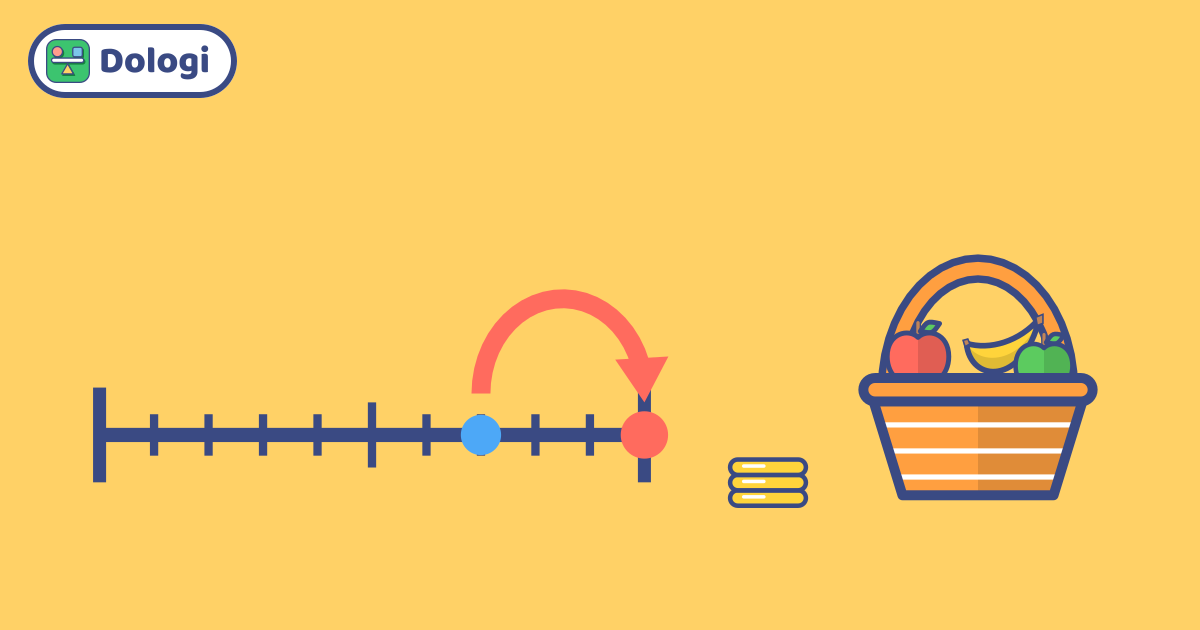
Rounding to the nearest ten means finding the closest multiple of ten. Draw a number line from 40 to 50 with ten small steps and ask: "Where is 47?"
- From 47 to 50 is only 3 steps. From 47 back to 40 is 7 steps. 50 is closer, so 47 rounds to 50.
- 43 is the other way round: 3 steps back to 40, 7 steps up to 50. 43 rounds to 40.
If you have a yard or sidewalk, chalk the number line, stand your child on 47 and let them hop to the nearest ten. Steps counted with their feet are steps they remember.
Exactly in the middle: the school rule
45 is five steps from 40 and five steps from 50. Neither is closer, so we need an agreement so that everyone gets the same answer. At school, children look at the digit just to the right of the place they're rounding to: 4 or less, round down; 5 or more, round up. Many teachers use the rhyme "Five or more, raise the score. Four or less, let it rest." So 45 rounds to 50.
When writing, we use the "approximately equal" sign: 47 ≈ 50. The ordinary equals sign is only for things that are truly equal.
Look at just one digit
To round to the nearest ten, look at the ones digit. To round to the nearest hundred, look at the tens digit and ignore the ones.
The most common mistake is chain rounding: to round 348 to the nearest hundred, a child goes 348 → 350 → 400. Wrong, because 348 sits between 300 and 400 and is closer to 300 (48 away from 300, 52 away from 400). The right answer is 348 ≈ 300: the tens digit is 4, so round down.
Another mistake: thinking rounding means chopping off digits, so 47 becomes 40. Chopping always goes down; rounding finds the nearest.
What rounding is for
Adding up the shopping in your head. Three items cost $1.80, $3.20 and $2.70. Round each to the nearest dollar: $2 + $3 + $3 = $8. The real total is $7.70, very close. Standing at the checkout, your child can say "about eight dollars" straight away.
Checking whether an answer makes sense. Your child works out 398 + 207 and gets 505. Round to the nearest hundred: 400 + 200 = 600. 505 is too far from 600, so something went wrong. Working it again gives 605: they forgot to carry the 1 into the hundreds.
When to round up, when to round down
In real life, the situation sometimes decides, not the "5 or more" rule:
- To be sure you have enough, round up. Is a $10 bill enough for those three items? Round everything up: $2 + $4 + $3 = $9. Still under $10, so it's definitely enough.
- When everyone needs a place, round up. 23 children, tables that seat 10: 23 is closer to 20, but with 2 tables three children would be left standing. You need 3 tables.
- When only whole things count, round down. You have $4.50 and stickers cost $1 each. $4.50 rounds to $5, but you can only buy 4 stickers.
Asking "Is it safer to round up or down here?" is a great thinking question.
Practice from easy to harder
| Number | To the nearest ten | To the nearest hundred |
|---|---|---|
| 243 | 240 | 200 |
| 365 | 370 | 400 |
| 348 | 350 | 300 (not 400) |
| 451 | 450 | 500 |
| 250 | 250 | 300 |
| 997 | 1000 | 1000 |
The 997 row often puzzles children: to the nearest ten, 99 tens and 7 ones is closer to 100 tens, which is 1000.
By age
- 6–7: no rule yet. Play "which ten is closer?" on a number line, counting steps both ways.
- 8–9: round to the nearest ten and hundred; add up shopping in your head; round to check addition and subtraction.
- 10–12: round decimals. 3.46 to one decimal place is 3.5, and to the nearest whole number is 3 (not 4: chain rounding again). Choose to round up or down depending on the situation.
The Math topic in Dologi has a puzzle called Number line hops, which at harder levels asks: "What number is the rabbit standing on?" Only a few numbers are written on the line, so children count the marks to find where the rabbit is: exactly the skill for seeing which round number a number is near.
In short
- Rounding finds the nearest round number; a number line shows which side is closer.
- Exactly in the middle, follow the agreement: 5 or more, round up.
- Look only at the digit just to the right of the place you're rounding to; don't chain-round.
- Use rounding to add up money, check answers, and choose up or down to suit the situation.
Read more: Teaching children to estimate, A sidewalk chalk number line, Tens and ones