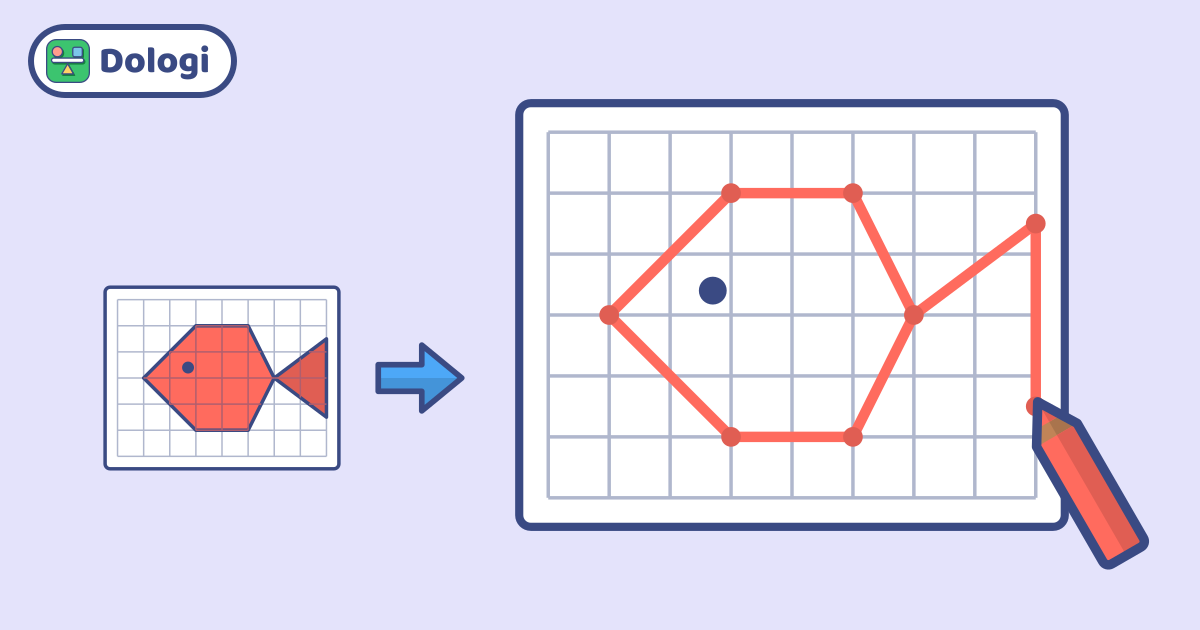
Around upper elementary, scale starts showing up everywhere: the little bar in the corner of a map, the "1:64" on the bottom of a toy car, the math worksheet that asks for a drawing "twice as big." In the US, scale drawings are a formal topic around 7th grade, but the idea underneath is simple enough for an 8-year-old with a pencil and some graph paper. Here are four hands-on ways in.
What scale really means
One sentence covers it: every length is multiplied by the same number. That number is the scale factor. Double the scale and every line is twice as long. Halve it and every line is half as long. The shape doesn't change, and neither do the corners: a right angle stays a right angle.
The most common mistake is adding instead of multiplying. Try this with your child on graph paper:
| Rectangle | Short side | Long side | Does it look the same? |
|---|---|---|---|
| Original | 2 squares | 4 squares | |
| Add 2 to each side | 4 squares | 6 squares | No, it looks chunkier |
| Multiply each side by 2 | 4 squares | 8 squares | Yes, same shape, bigger |
The original's long side is twice the short one. After adding 2, it's only one and a half times as long, so the rectangle gets "fatter." After multiplying by 2, the long side is still twice the short one. Let your child cut out all three, stack them with one corner lined up and lay a ruler along the diagonal of the original: it runs straight through the opposite corner of the doubled rectangle, but misses the corner of the one that got 2 added.
Enlarge a picture on a bigger grid
This is the activity on the cover, and it's the best place to start.
- On graph paper with small squares (quarter-inch is fine), draw a simple picture whose corners sit on grid points: a fish, a house, a rocket. Keep it to straight lines at first.
- On a bigger sheet, draw a grid with the same number of squares, but each square twice as wide. A ruler and a pencil are enough: mark every half inch along the top and the side and join the marks.
- Copy the picture square by square. First mark every corner as a dot (three squares across, two down), then join the dots.
- Lay the two pictures side by side and ask: "How many times longer is each line now?"
Then turn it around: shrink a picture onto a smaller grid. And for a laugh, copy it onto a grid of tall, narrow rectangles. The fish comes out stretched. That stretched fish is the point: a picture only keeps its shape when it grows by the same amount in both directions.
For older kids, there's a surprise hiding here. Count how many small squares fit inside one big square. When the sides are twice as long, one big square holds four small ones, so the fish covers four times as much paper. Triple the sides and it's nine times. Length and area don't grow at the same rate.
Maps: from a few inches to a real walk
A map is a scale drawing of a real place, shrunk down a lot. The scale bar tells you how much: one inch on the paper might stand for a hundred feet, a mile, or more.
Try it with a map of your neighborhood, printed or on a phone screenshot:
- Find the scale bar and mark its length on the edge of a strip of paper.
- Lay a piece of string along the way from home to school or to the park, following the turns.
- Straighten the string and see how many scale-bar lengths it covers. That's the real distance.
- Next time you walk that way, count steps or check the time. Does it feel about right?
Draw your own scale plan
Now flip it: your child makes the scale drawing. A bedroom works well. Measure it with a tape measure, then draw it on graph paper where one square stands for one foot. A room that's 10 feet by 12 feet becomes 10 squares by 12. A twin bed, a little over 6 feet long and about 3 feet wide, becomes a strip of about 6 squares by 3. Cut the furniture out of paper at the same scale and move it around to see what fits before anyone pushes a real dresser.
Models: how big would the real thing be?
Many small die-cast cars are made at a scale of 1:64, and that number is often printed underneath. It means every length on the toy is 64 times shorter than on the real car.
- Measure the toy car. A typical one is around 3 inches long.
- Multiply: 3 × 64 = 192 inches. Divide by 12 and you get 16 feet.
- Go out to the driveway or a parking lot with a tape measure and check a real car. Most family cars are somewhere around 14 to 16 feet long, so the toy is in the right range.
Then go the other way: make a paper model of something at a scale you choose. A bed, the kitchen table, the family car at 1:20. Children quickly learn to ask "times what?" before they start cutting.
Ideas by age
- Around 8 to 9: doubling a picture on a grid, with the "add or multiply?" rectangles.
- Around 9 to 10: map strings, scale bars and a room plan at one square to one foot.
- Around 11 to 12: the area surprise (twice the side, four times the area), toy car scales, and with blocks, the volume surprise: a cube with edges twice as long takes eight small cubes to build, since 2 × 2 × 2 = 8.
All of this rests on one habit: reading a position by column and row and putting it in the same place on another grid. In the Space topic of Dologi, the Turn or flip, then draw puzzle uses that same habit: children tap squares on a grid to redraw a block after a quarter turn or a flip.
In short
- Scale means multiplying every length by the same number; the shape and the angles stay the same.
- Adding the same amount to every side changes the shape. Multiplying keeps it.
- Copying a picture square by square onto a bigger grid is the easiest way in; a map with a string and a toy car with a tape measure make it real.
- Twice the length means four times the area and eight times the volume.
Read more: Grid drawing and symmetry for children: copy, mirror and fold to check, Draw a map of your child's room: seeing things from above, Which lemonade is sourer, which pack is cheaper? Comparing ratios for 9 to 12 year olds