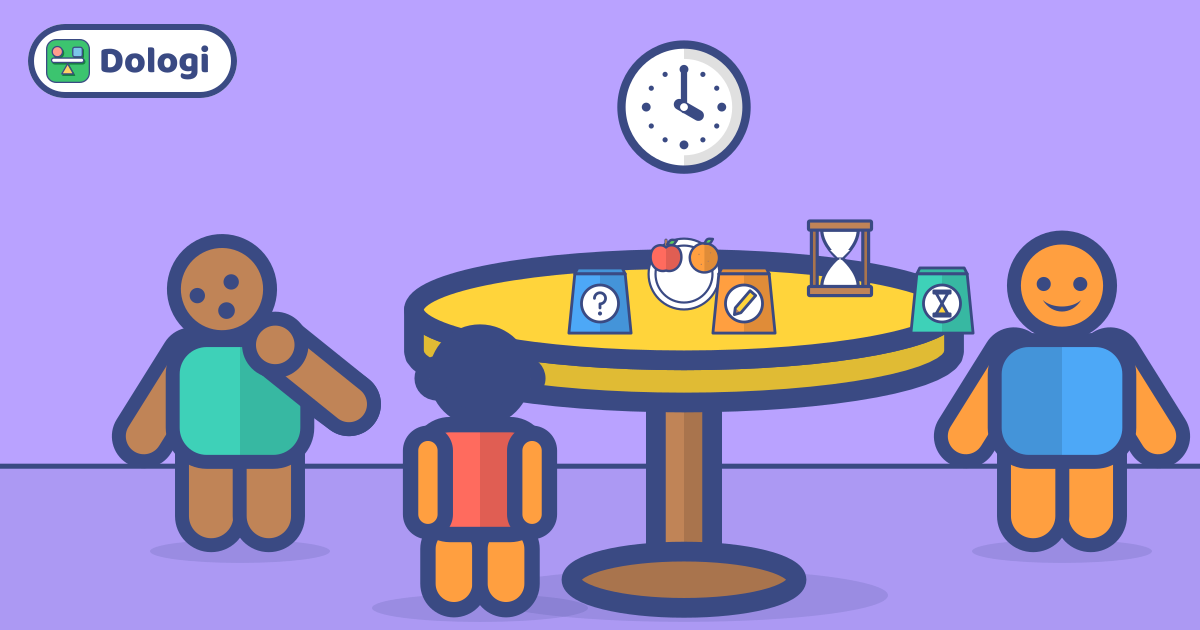
The spelling test is on Friday, so your child asks if two classmates can come over to "study together." You clear the kitchen table and slice some apples. An hour later the books haven't moved, and the three of them are seeing whose paper airplane flies farthest. This happens in a lot of homes, and it isn't laziness. Nobody has told the kids what studying together actually looks like.
A study group works when it has a little structure: everyone has a job, there's a start and an end, and play comes after the work. This post covers how to split roles for a group of three, how to have kids write review questions for each other, and what you should and shouldn't do while they work.
When a study group helps
Study groups fit best from about age 8 to 12, once your child can read the material alone and wait for a turn. For younger kids, a playdate with a light review game usually works better.
Groups are best for reviewing what was already taught in class: spelling words, times tables, vocabulary, the steps for a type of math problem, the parts of a plant or the layers of the Earth. When your child has to pull an answer out of memory for a friend's question, or explain something a friend didn't get, it sticks far better than rereading notes alone.
A study group is not for copying each other's homework. Each child still does their own assignments. The group is for asking, answering and checking.
Two to four kids is plenty. Three is often easiest: enough people to share the jobs, few enough that nobody ends up on the sidelines.
Set it up the day before
A smooth session is mostly planned ahead:
- Pick one thing to study. "Chapter 5 science vocabulary" or "the 6s, 7s and 8s," not "everything for the test."
- Decide what each child brings. Their book, notes, a pencil, and two review questions written on cards (more on that below).
- Set a time. About 45 to 60 minutes of studying, then free play. Tell the other parents when to pick up.
- Choose the spot. A table big enough for three, away from the TV and the toy bin. Phones and tablets stay in another room.
- Put out shared supplies. A sand timer or kitchen timer, a stack of index cards, and a few colored pens.
Three roles that rotate
The key is giving each child a clear job. With three kids, use three roles and switch every 10 minutes or so:
| Role | What they do | What they use |
|---|---|---|
| Asker | Reads a question out loud, waits for the answer, then flips the card | The stack of question cards |
| Answerer and recorder | Answers, then writes down any question they missed or weren't sure about | Paper and pencil |
| Timekeeper | Starts the timer, calls time, and steers the group back when it drifts off topic | Sand timer or kitchen timer |
When the round ends, everyone moves to the next role. After three rounds each child has done all three jobs, and there are three "still working on it" lists on the table to take home.
Colored cards help: blue for the asker, yellow for the recorder, red for the timekeeper. Kids like holding their own card, and anyone can see who's doing what, which cuts down on "that's not fair."
Each child writes two review questions
Before the session, each child writes two questions about the material on index cards: the question on the front, the answer and page number on the back. This is often where the most learning happens, because you have to understand a topic to ask a good question about it.
Tips to share with your child:
- Ask about what matters, not trick details. "What does a plant need to make its own food?" beats "How many pictures are on page 34?"
- Mix the kinds of questions. One "what is" question and one "why" or "what would happen if" question.
- Know the answer. The asker has to be sure, and the page number lets the group check when there's a disagreement.
- Add one "look and remember" warm-up. Put five school supplies on the table, let everyone look for ten seconds, cover them, and take one away. Which one is missing? It gets brains going before the real questions.
When someone gets it wrong, the asker doesn't just say "nope" and read the answer. Give one hint first ("think about the picture of the plant in the book"), then flip the card. Kids who can explain something to a friend are learning it best.
For more on making question cards, see homemade flashcards.
Study first, play after, parents nearby
A one-hour session might look like this:
- 5 minutes: sit down, set out supplies, put everyone's question cards in the middle and shuffle.
- 30 minutes: three rounds, switching roles every 10 minutes.
- 10 minutes: snack break.
- 10 minutes: go over the three "still working on it" lists and ask each of those questions once more.
- After that: free play until pickup.
Say "study first, then play" at the start and keep your word. When kids know the fun is coming for sure, they settle into the work more easily.
Stay close, but don't sit at the table. Do your own thing in the next room or at the kitchen counter, near enough to hear. When a parent sits down with the group, kids tend to ask the adult instead of each other, and the quieter child talks even less. Step in only if an argument drags on or it's break time.
Some common bumps:
- The group drifts off topic. The timekeeper gets to say "back to the cards." If that doesn't work, wander over and ask "which round are you on?" instead of scolding.
- One child can't keep up. Let them be the asker first, since the asker sees the answers. Remind everyone: no teasing, no laughing at wrong answers.
- One child takes over. Rotating roles helps, but you may need a quiet "let your friend try first."
If your child often comes home saying nobody listens to them in groups, group work at school has ideas for talking it through. If the same problem keeps coming up and it's upsetting your child, it's worth checking in with their teacher, who sees the kids working together every day.
In the Memory topic in Dologi, puzzles like Memory cards and What disappeared? use the same "look, remember, answer" idea as the warm-up. Kids can try one during the break, then invent a similar one for their friends.
In short
- Study groups work best for reviewing material, with two to four kids around 8 to 12. Homework stays each child's own.
- Rotate three roles (asker, answerer and recorder, timekeeper) every 10 minutes.
- Have each child write two question cards with answers; writing questions is studying too.
- Study first, play after, and say so up front. Stay nearby, but not at the table.
Read more: Homemade flashcards, Group work at school, Cooperative games when friends come over