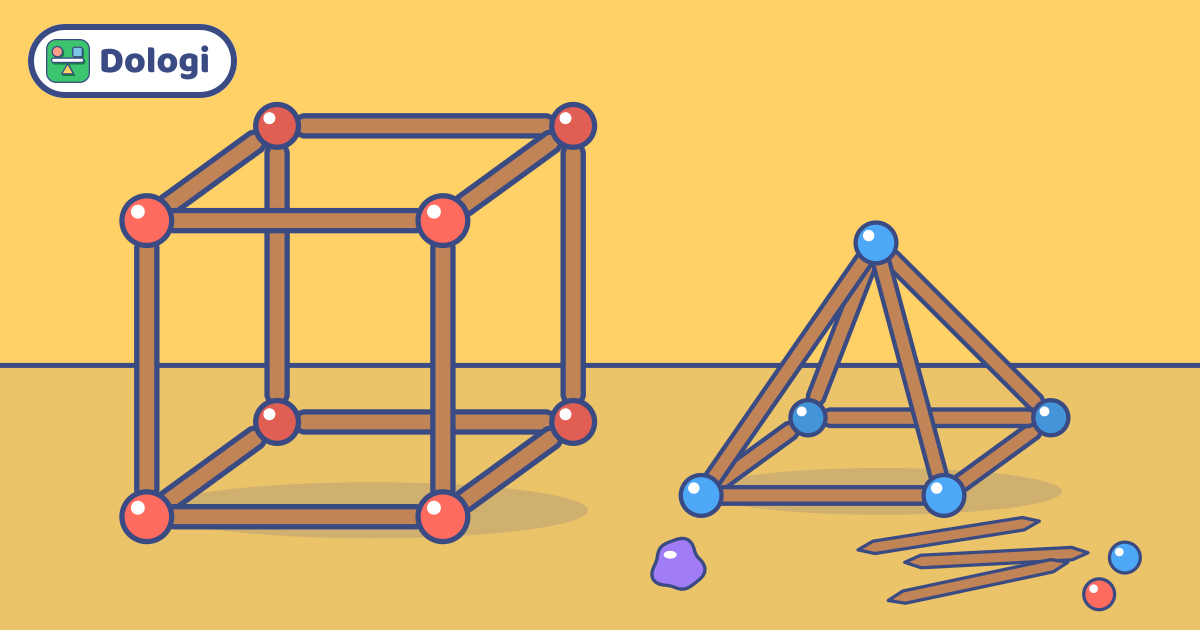
"A cube has 8 vertices, 12 edges and 6 faces." Children can memorize that sentence for a test and forget it a week later, because a picture of a cube on a page hides half of its edges. Build the cube with toothpicks and little balls of clay, and every part becomes something you can touch: each ball is a vertex (a corner), each toothpick is an edge, and each "window" framed by toothpicks is a face.
This post walks you through a cube, a pyramid and a prism, a guessing game that turns counting into reasoning, and a pattern older kids can discover for themselves. It works best for children around 7 to 11; younger kids can join in with straws.
What you need, and keeping it safe
- A box of round toothpicks (all the same length).
- Modeling clay or play dough, rolled into balls about the size of a pea. Mini marshmallows work too and are easier to push onto the sticks.
- A tray or a placemat, so the clay stays off the table.
Toothpicks have sharp points. For children under about 7, or anyone who still puts things in their mouth, use drinking straws cut into equal pieces about 2 inches long, or cotton swabs, with larger balls of play dough. Older children can use toothpicks with an adult nearby. Put the box away when you're done.
Build a cube first
Start with the cube, because every child knows what it should look like.
- The bottom: four balls and four toothpicks make a square lying flat on the tray.
- The walls: push one toothpick straight up into each ball.
- The top: put a ball on each standing toothpick, then join the four top balls with four more toothpicks.
Now count together, slowly:
- Vertices: count the balls. There are 8.
- Edges: count the toothpicks. There are 12. To avoid counting one twice, count the 4 on the bottom, the 4 on top, then the 4 standing up.
- Faces: this is the tricky one, because the faces are empty. Hold a square of paper against each window, or let your child touch each one with a finger: bottom, top, front, back, left, right. That makes 6.
Children often find the cube leans or slowly squashes sideways. That's not a mistake, it's a discovery worth a few minutes (see "Why the cube wobbles" below).
Guess first, then build
Before each new shape, ask your child to predict how many balls and toothpicks it will need. Write the guesses down, build the shape, then check. Being wrong is part of the fun; the point is to look for a way to count without building.
| Shape | Vertices (balls) | Edges (toothpicks) | Faces |
|---|---|---|---|
| Cube | 8 | 12 | 6 |
| Square pyramid | 5 | 8 | 5 |
| Triangular pyramid | 4 | 6 | 4 |
| Triangular prism | 6 | 9 | 5 |
How to build them:
- Square pyramid: make a square for the base, push a toothpick up from each corner and lean all four together into one ball at the top.
- Triangular pyramid: a triangle for the base, three toothpicks leaning in to one ball. All six edges are the same length, which makes it a neat, sturdy shape.
- Triangular prism: two triangles, one on the tray and one held above it, joined by three standing toothpicks. It looks like a tent.
Older children can find a shortcut for edges. Each ball on the cube has 3 toothpicks stuck into it, so 8 balls × 3 = 24 toothpick ends. Every toothpick has 2 ends, so 24 ÷ 2 = 12 toothpicks. Try the same trick on the square pyramid: the top ball holds 4 toothpicks and each of the 4 base balls holds 3, so 4 + 12 = 16 ends, and 16 ÷ 2 = 8 toothpicks.
Why the cube wobbles
Push gently on the top of the cube, and it leans over like a falling box. Push on the triangular pyramid, and it holds its shape. A square made of sticks can squash into a diamond, but a triangle can't change shape unless a stick bends or breaks.
Challenge your child to make the cube stand firm. The fix is a stick across one face, corner to corner. It has to be longer than a toothpick, so an adult can cut a piece of straw or a bamboo skewer to fit. That splits the square into two triangles, and the cube stops leaning in that direction. How many braces does it take before the whole cube stands firm? Afterward, look for triangles in bridges, cranes, roof frames and ladders on your next walk.
A pattern for older kids
Children around 10 or 11 can go further with prisms and pyramids that have bigger bases. Build a few, fill in the table and look for patterns.
| Base | Prism: V / E / F | Pyramid: V / E / F |
|---|---|---|
| Triangle (3 sides) | 6 / 9 / 5 | 4 / 6 / 4 |
| Square (4 sides) | 8 / 12 / 6 | 5 / 8 / 5 |
| Pentagon (5 sides) | 10 / 15 / 7 | 6 / 10 / 6 |
Some questions to ask:
- "A prism has two bases. How does its number of edges relate to the sides of the base?" (three times as many)
- "Without building it, how many toothpicks does a prism with a 6-sided base need?" (18)
- "Take vertices, subtract edges, add faces. What do you get?" For the cube, 8 − 12 + 6 = 2. For the pentagonal pyramid, 6 − 10 + 6 = 2. It comes out to 2 for every shape in the table. Mathematicians call this Euler's formula, and finding it by building is much more satisfying than reading it.
In England, children start describing edges, vertices and faces in Year 2; in the US, these words usually show up somewhere in elementary school. Either way, a frame they built themselves makes the words stick.
In Dologi, the Space topic has "Fold a cube" puzzles: children decide which flat shape of six squares folds into a cube. Once your child has counted the 6 faces on a toothpick cube, it's a natural next step.
In short
- Clay balls are vertices, toothpicks are edges, and the empty windows are faces. Count each one by touching it.
- Start with a cube (8, 12, 6), then guess and check a pyramid and a prism.
- Count edges without building: balls × toothpicks per ball, divided by 2.
- Squares wobble, triangles hold. For older kids, vertices − edges + faces always makes 2.
Read more: Solid shapes around the house: boxes, balls and cylinders for kids, Is a square a rectangle? Helping kids understand shape families, From flat shape to box: cube nets for children