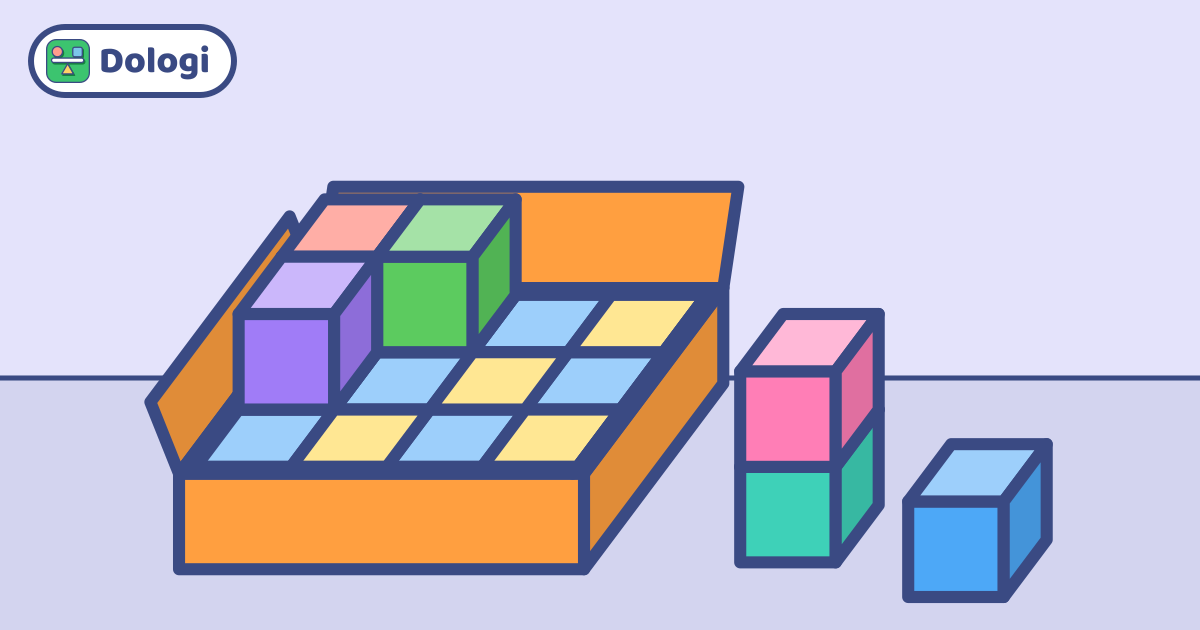
Many kids can recite "volume equals length times width times height" and still have no idea what the answer means. Ask what "24 cubic inches" looks like and you often get a shrug. Volume is actually one of the easiest ideas in math to hold in your hands: it's just how many cubes it takes to fill something. Give your child a small box and a pile of cubes, and the formula will make sense on its own.
What you need
- Cubes that are all the same size. Classroom 1-inch cubes, 1-centimeter cubes, wooden blocks, sugar cubes or a handful of dice all work. The only rule: every cube is identical.
- A small box with straight sides. A tea box, a jewelry box, a box from a phone charger or the bottom of a shoebox.
- A ruler and some paper for notes.
Before you start, ask your child to guess: "How many cubes do you think will fit?" Write the guess down. Kids love checking it later, and guessing first builds a feel for size that formulas alone don't give.
Fill one layer, then count the layers
Have your child cover the bottom of the box with cubes, packed tightly in rows. Say the box fits 4 cubes along the long side and 3 along the short side. That's 3 rows of 4, so one layer holds 4 × 3 = 12 cubes. This is the same idea as area: the bottom of the box is covered by 12 squares.
Now ask: "How many layers will fit before we reach the top?" If the box is 2 cubes tall, there are 2 layers of 12, so the box holds 12 × 2 = 24 cubes. That's length × width × height: 4 × 3 × 2.
The big moment comes when your child realizes they don't need to fill the whole box. A row of cubes along the length (4), a row along the width (3) and a stack in one corner (2) is enough information. The rest is multiplication.
| Box (cubes along each edge) | One layer | Layers | Total |
|---|---|---|---|
| 4 × 3 × 2 | 12 | 2 | 24 |
| 5 × 2 × 3 | 10 | 3 | 30 |
| 3 × 3 × 3 | 9 | 3 | 27 |
Same volume, different shapes
Give your child exactly 24 cubes and a challenge: build as many different solid boxes as you can, using all 24 every time.
- 4 × 3 × 2
- 6 × 2 × 2
- 8 × 3 × 1
- 12 × 2 × 1
- 24 × 1 × 1, a long "snake"
Every one has a volume of 24 cubes, even though a flat slab and a long snake look nothing alike. This is great practice for spotting that two very different-looking containers can hold the same amount.
For older kids, add a twist: count the squares on the outside of each box, as if you were wrapping it in paper. The 4 × 3 × 2 box has 52 square faces on the outside, while the 24 × 1 × 1 snake has 98. Same inside, almost twice the wrapping paper. It's the 3D version of the classic "same perimeter, different area" puzzle.
A box that holds exactly one liter
Here's an experiment that connects volume to the bottles in your fridge. Help your child make an open box with each inside edge exactly 10 centimeters long: five squares of stiff cardboard taped together (a base and four sides). Line it with a plastic zip bag so it doesn't leak.
Now pour in a 1-liter bottle of water, or four 250 mL cups if you have a measuring cup. The box fills almost exactly to the top. That's because 10 × 10 × 10 = 1,000 small cubes of 1 cubic centimeter, and 1,000 cubic centimeters is one liter. So each tiny centimeter cube holds 1 milliliter, about 20 drops of water.
Prefer less mess? Use dry rice or beans instead of water. And for a quick American comparison: a quart is a little less than a liter, so a quart of milk would leave a small gap at the top.
Mix-ups children often make
- Counting only the cubes they can see. In a drawing of a stacked box, many cubes are hidden behind and underneath. Remind your child to count layer by layer, not just the visible faces.
- Mixing up the units. Length is in inches or centimeters, area in square units, volume in cubic units. Ask: "Is this a length, a number of squares or a number of cubes?"
- Adding instead of multiplying. 4 + 3 + 2 = 9 is not the volume. Building the box with real cubes fixes this fast.
- Mixing inches and centimeters. If one edge is measured in inches and another in centimeters, the answer means nothing. Pick one unit for all three edges.
What to try at each age
- Ages 9 to 10: fill boxes with cubes and count rows and layers. In the US, volume usually comes up in 5th grade; in England, children build cuboids from centimeter cubes around Year 5.
- Ages 10 to 11: use the formula on real boxes measured with a ruler, then check by building a smaller model.
- Ages 11 to 12: cubic centimeters and liters, boxes with half-centimeter edges, and L-shaped solids split into two boxes. Questions to try: how many juice boxes fit in a shipping box? Which cereal box holds more?
The Space topic in Dologi has a puzzle called Count the cubes. A stack is drawn at an angle and your child counts every cube, including the hidden ones. The prompt reminds them to count each tower from its top down, which is the same "towers times height" thinking behind length × width × height.
In short
- Volume is how many cubes fill a space; one layer is length × width, and the layers stack up to the height.
- You don't need to fill the whole box: one row along each edge is enough, then multiply.
- 24 cubes can make a slab, a tower or a long snake: same volume, very different shapes.
- A 10 cm cube holds exactly 1 liter, because 1,000 cubic centimeters make a liter.
Read more: Perimeter and area for kids: going around the edge vs. covering the inside, Solid shapes around the house: boxes, balls and cylinders for kids, How many cubes are in the stack? Counting the blocks you can't see