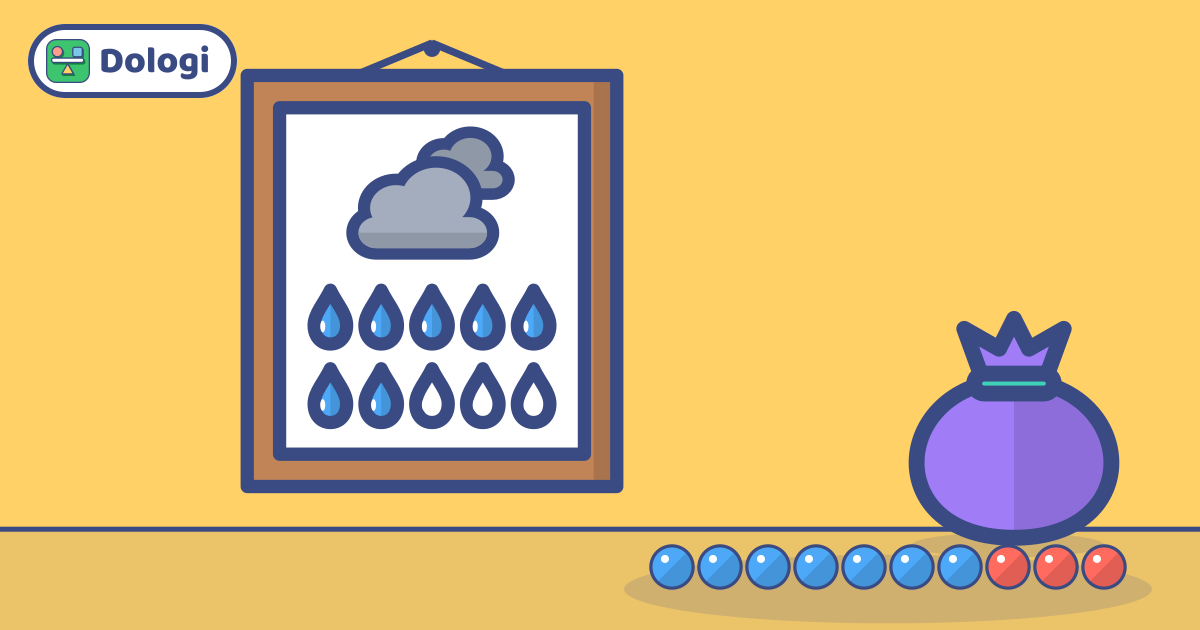
The weather app says "70% chance of rain this afternoon." Your child has a few ideas about what that means. It will rain, for sure. Or it will rain for 70% of the afternoon. Or, if the afternoon stays dry, the forecast was wrong. None of these is quite right, and sorting them out is a great way into probability.
This post is for parents of children aged about 9 to 12 who already know a little about percentages. It explains in plain words what a chance of rain means, then gives you a marble game, a forecast diary and some everyday examples to try together.
What "70%" actually says
70% means 70 out of 100, which is the same as 7 out of 10. A simple way to put it for children: if there were 10 days with weather just like today's, we would expect rain on about 7 of them and no rain on about 3.
A few things the number does not say:
- Not how long it rains. 70% isn't 70% of the afternoon. It's about whether any rain falls at all during the time the forecast covers.
- Not how hard it rains. A 70% chance can bring a short drizzle. A 30% chance can bring a downpour.
- Not a promise. "Likely" is not "certain." If a 70% day stays dry, the forecast wasn't necessarily wrong: it already told us that about 3 days in 10 like this one stay dry.
Weather services word their definitions a little differently, but the core idea is the same: the number tells you how likely it is that you'll get at least some rain where you are.
A bag of ten marbles
Put ten marbles in a bag you can't see through: seven blue (rain) and three red (no rain). This bag is a "70% chance of blue."
- Before each draw, ask: "Which color do you expect?" Most children say blue, and that's a good prediction.
- Draw one without looking, write down the color, and put it back.
- Do ten draws. You might get 6 blues, or 9, or exactly 7. Red will almost certainly come up at least once, even though blue is more likely.
- Now do 50 draws and keep a tally. Over many draws, the share of blues usually gets closer to 7 out of 10, around 35 out of 50.
Then change the bag and talk about what each one would mean as a forecast:
| Blue / red marbles | Chance of blue | Like a forecast of |
|---|---|---|
| 10 / 0 | 10 out of 10 = 100% | Rain is certain |
| 9 / 1 | 9 out of 10 = 90% | Very likely to rain |
| 7 / 3 | 7 out of 10 = 70% | Likely to rain |
| 5 / 5 | 5 out of 10 = 50% | As likely as not |
| 3 / 7 | 3 out of 10 = 30% | Rain is possible, but less likely |
| 0 / 10 | 0 out of 10 = 0% | No rain expected |
The big lesson: three red marbles out of ten is not a small thing. With a 70% chance, getting a dry afternoon is perfectly normal.
Keep a forecast diary
Each morning, your child writes down the chance of rain for the afternoon. In the evening, they write whether it actually rained. A page might look like this:
| Day | Chance of rain | Did it rain? |
|---|---|---|
| Monday | 70% | Yes |
| Tuesday | 20% | No |
| Wednesday | 70% | No |
After a week, ask: "Was the forecast right?" This is a trickier question than it looks. One week is far too few days to judge. To check a 70% forecast, you need many 70% days: about 7 in 10 of them should end up rainy. Keep the diary going for a month or a whole rainy season and group the days by their forecast. Your child is now doing what scientists do: checking a prediction against lots of real results.
The diary also leads to good decisions. "It's 30% today. Will you bring a raincoat?" There's no single right answer. It depends on how bad getting wet would be. A 30% chance is easy to ignore on the way to the park, but maybe not on the day of a class photo.
Chance numbers all around us
Once your child knows what to look for, chance numbers show up everywhere:
- Drawing names from a hat to pick who goes first: with 4 names, each person has a 1 in 4 chance, or 25%.
- Board games: on a fair die, rolling a 6 is 1 chance in 6, a little under 17%.
- Sports: a commentator says a team has a "good chance" of winning. It's an estimate, not a result. Upsets happen.
For each one, ask the same two questions: "Out of how many?" and "Does likely mean certain?"
Practice with Dologi
In Dologi's Math topic, the Equal parts puzzles ask questions like "Which one is colored as much as this one? Look at the whole shape, don't count parts." Seeing that 7 colored parts out of 10 is the same amount as a bar that's 70% colored is exactly the skill behind reading a forecast: a chance is a part of a whole.
In short
- A 70% chance of rain means about 7 out of 10 days like this one get rain, and about 3 stay dry.
- It says nothing about how long or how hard it rains, and it's not a promise.
- A bag with 7 blue and 3 red marbles shows that "likely" still leaves room for the less likely result.
- A forecast diary teaches that you judge predictions over many days, not one.
Read more: Probability for young children: certain, possible or impossible?, Percentages for 10 to 12 year olds: from a cake to a sale price, Seasons and weather for kids