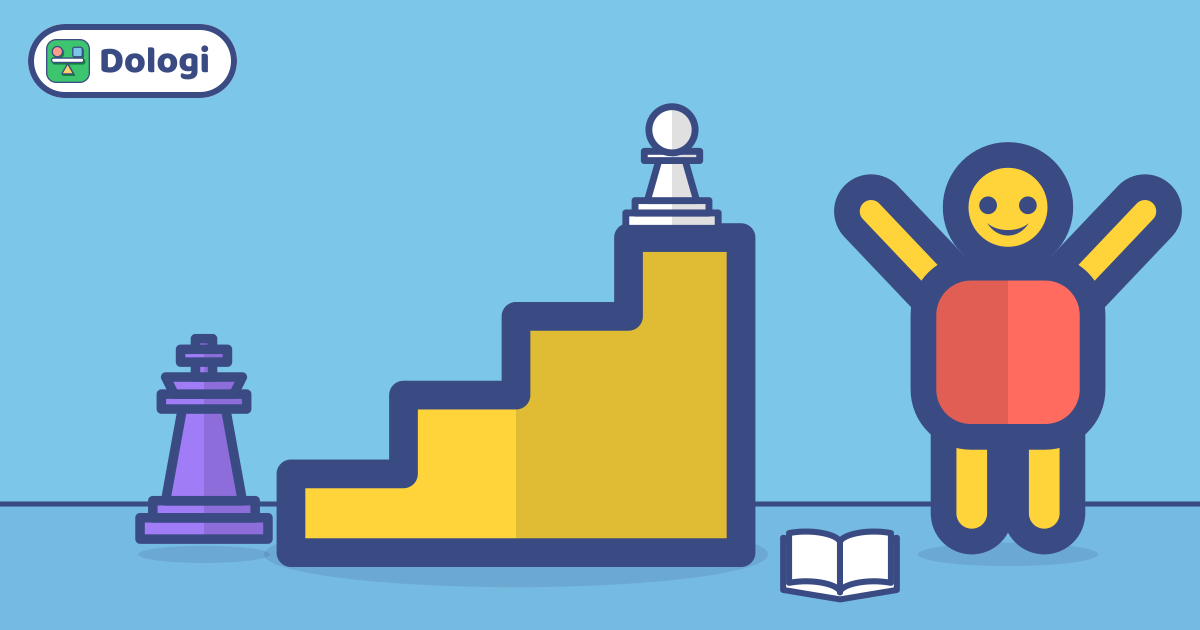
It happens on an ordinary evening. You set up the board after dinner, you play your usual game, and twenty minutes later your king is trapped. You check twice. It's real: your child just beat you, and nobody let anybody win. A week later it happens again, and then it becomes normal.
Many parents feel a little lost at this point. If you are no longer the tougher player, what is your job? The good news is that your role doesn't end. It changes. You go from being the opponent to being the one who asks questions, keeps the score sheet, takes lessons, finds new opponents and protects the fun. None of that requires you to be the stronger player.
Celebrate it honestly
Say it plainly: "You beat me fair and square. That knight move really surprised me." Skip the excuses, like "I was tired" or "I wasn't paying attention." Kids notice when an adult takes a win away from them, even gently.
Praise the specific thing your child did: the plan, the move that set up the attack, the patience to wait for your mistake. "You kept your queen safe the whole game" means more than "You're a genius," and it tells your child what to keep doing.
It's okay to feel two things at once: proud, and a tiny bit stung. Laugh about it out loud. Your child will enjoy seeing that a grown-up can lose with good humor. Then keep playing. A game you lose is still a good game for both of you. If you used to give your child extra pieces to even things out (see should you let your child win at chess), you can flip it now and let your child give you a head start. Kids usually find that very funny.
From opponent to questioner and game recorder
You don't need to know the right answer to ask a good question. Try these after a game, or even during one:
- "Why did you choose that move?"
- "What do you think I was planning there?"
- "Where did the game turn?"
- "If you could take back one move, which would it be?"
Questions like these make your child put their thinking into words, and that is where a lot of learning happens. There are more ideas in questions to ask when playing chess with kids.
You can also become the family's game recorder. Write the moves down in simple notation on a notepad, or just snap a photo of the board on your phone when something interesting happens. Later, sit down together and let your child lead the review: "Show me what happened here." You're the one holding the notebook, not the one giving the lecture. The post on reviewing chess games with your child has a simple way to do it without criticism.
Ask your child to teach you
Teaching is a great test of understanding. When your child explains an idea, you both find out what they really know and where they're still a bit fuzzy.
Ask for one small idea at a time:
- How do you checkmate with just a king and a rook?
- Why should you castle early?
- What's your favorite trap, and how do you avoid falling into it?
Be a real student. Ask "why?" when you don't get it. Make honest mistakes and let your child correct you. If your child says "No, the rook goes here first," you've just watched them think like a teacher.
Some kids love turning the tables completely and inventing chess puzzles for you to solve. That's a fun next step, explained in your child makes up chess puzzles to stump you.
Find partners at the right level
Kids enjoy chess most when they win some and lose some. Winning every game gets boring, and losing every game gets discouraging. Now that you're not enough of a challenge, help your child find a good mix of opponents:
- School: a chess club, an after-school program or a lunchtime chess table.
- Community: a library chess corner, a community center group, or a local club that welcomes kids.
- Family: cousins, older kids in the neighborhood, a grandparent who used to play.
- Online: only if you set it up and stay nearby. Use an account without personal details, turn chat off and keep the screen in a shared room.
If you're weighing the options, chess class, chess club or learning at home compares them side by side.
Keep chess their own joy
When a child gets good at something, the adults around them sometimes get more excited than the child. Watch for signs that chess is turning into pressure:
- Your child seems to play mostly to please you.
- Any loss leads to big tears or anger that lasts.
- Your child keeps asking about ranks, ratings or who is "better."
- The spark is gone and chess feels like homework.
What helps:
- Let your child set the pace, including how often to play.
- Tournaments only if your child wants to try one.
- Breaks are fine. Chess will still be there in a month.
- Keep plenty of family time that has nothing to do with chess.
- Never compare your child with a sibling, a classmate or anyone else.
If you notice stress that doesn't go away, talk with your child's teacher or club leader about what they see.
When you're no longer a tough enough opponent, the Chess room in Dologi's Creative corner has stronger chess buddies: the strongest are Owl, who knows mate in two, and Elephant, for when your child wants a hard game. In Challenges, positions are sorted By level from 1 to 12; at Level 9–12 the prompt only says which side moves and "Find the best move," like in a real game. And in Learn chess, the You teach switch lets your child pick a lesson and teach it to you or a friend, with hints for the "teacher."
In short
- When your child starts winning, celebrate honestly and praise the specific move or plan, not "talent."
- Switch roles: ask questions, record games and let your child lead the review.
- Become the student; teaching shows what your child truly understands.
- Find opponents at a mix of levels, and keep chess your child's own joy, not a pressure.
Read more: Don't tell them the move: questions to ask when playing chess with your child, Chess class, chess club or learning at home: which is right for your child?, Your child makes up chess puzzles to stump you: thinking backwards from checkmate