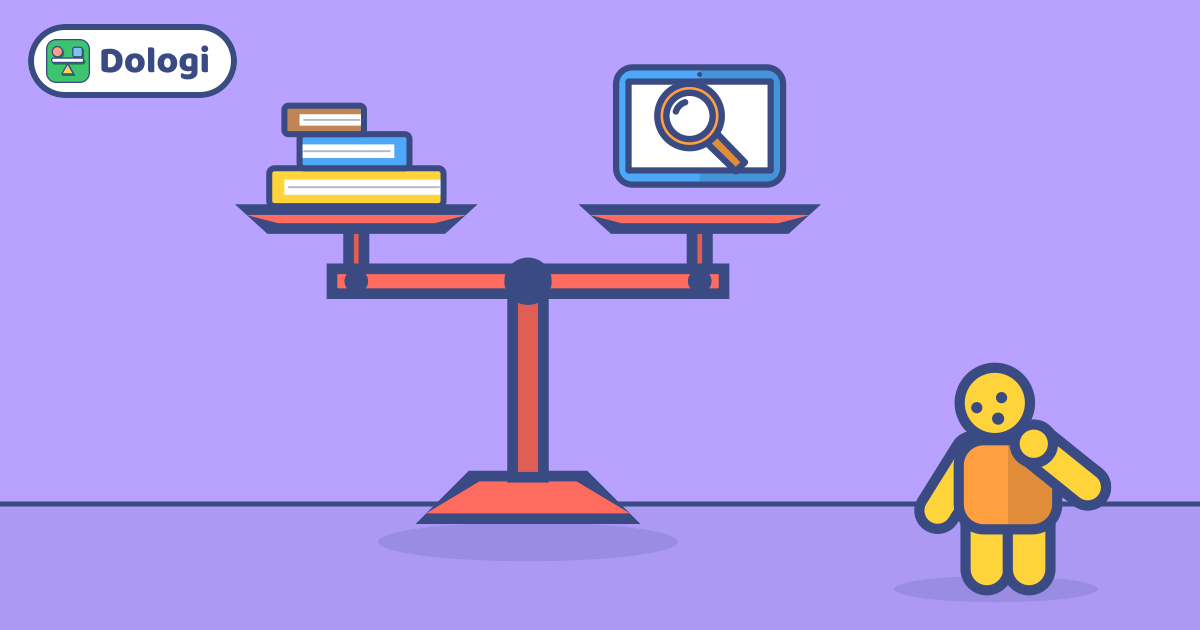
"Why do I have to learn my times tables? The phone can do it." Plenty of parents hear this, especially once kids notice that grown-ups ask a device about everything. It's a fair question, not back talk. Adults look things up all day, too.
But being able to look something up doesn't mean you don't need to know anything. Here's why what your child carries in their head still matters, plus a game for kids around 7 to 12 and a way to decide together what to learn by heart.
What your child knows helps new things make sense
New knowledge needs something to hold on to. "Whales have to come up to breathe" only sounds surprising if your child already knows that fish breathe underwater through gills. Without that, the sentence slides by like any other.
Knowing things also keeps reading smooth. If every third line of a science article has a word to look up, each stop to grab the tablet breaks the thread. Your child ends up knowing every word but not what the paragraph said.
Math works the same way. A child simplifying fractions who has to reach for a calculator to find 6 × 7 spends their attention on the small step, with nothing left for the hard part. Facts they know by heart are like tools hanging within reach: no thinking needed, so the effort goes where it counts.
Knowing things helps your child catch answers that make no sense
Calculators, websites and chatbots can all be wrong: a finger slips, a search misses a word, a page online is simply mistaken. Someone who knows nothing about the topic can only believe it.
A few examples your child might run into:
- They type 48 × 5 and get 2,040. If they can estimate "about 50 times 5 is 250," they see they hit an extra key.
- A page says cats live "200 years." Knowing Grandma's cat lived to about fifteen, they'll be suspicious right away.
- A translation app turns a Spanish sentence into odd-sounding English. Knowing a few key words, your child can guess where it went wrong.
Knowing things also tells your child what to ask next. For more on how chatbots come up with answers, see when your child chats with AI like a friend, and for checking one source against another, see teaching kids to compare two sources.
The "guess first, then look it up" game
This one works well for kids around 7 to 12, at dinner or in the car. The rules are short:
- Whoever has a question they want to look up says it out loud.
- Everyone makes a guess and explains why they guessed that.
- Only then do you look it up (in a book, on a device, or by asking someone who knows).
- Whoever was closest asks the next question. A guess that's way off is fine: the fun part is figuring out why it was off.
Some questions to start with:
| Question | What your child can use to guess |
|---|---|
| How many weeks are in a year? | A month has about four weeks, and a year has twelve months |
| How many miles is it to Grandma's house? | How many hours the drive takes, and about how far you go in an hour on the highway |
| An elephant weighs about as much as how many cars? | How big a car is, and how big an elephant looks next to one |
| At what temperature does water boil? | Something from science class, or a number seen on a kitchen thermometer |
| How long does it take a chicken egg to hatch? | Anyone who has seen eggs hatch at school or on a farm can share what they remember |
Guessing first makes your child dig up what they know and connect the pieces. When the answer comes, they're already holding a question ("Was I right?"), so it sticks instead of drifting away. The game also builds the habit of estimating, handy for checking what a device says. Estimation games for kids has more like this.
Make two columns together: "know it" and "look it up"
Nobody remembers everything, and nobody needs to. Divide a sheet of paper into two columns with your child:
| Know it by heart | Fine to look up |
|---|---|
| Addition and subtraction facts up to 20, the times tables | Unusual conversions, like ounces to grams |
| Spelling of words your child uses every day | Spelling and meaning of rare, tricky words |
| Mom's and Dad's phone numbers, your home address | A store's phone number, the bus schedule |
| The days of the week and the months in order | What date Thanksgiving falls on this year |
| A few big moments in your family's and the country's history | The exact date of something that happened long ago |
Choosing the column is a lesson in itself. Give your child four questions: "Do I use this every day?" "Do I need it fast?" "Do I need it to understand other things?" "What if I need it and there's no device around?" Two or more yeses puts it in the first column. A parent's phone number is the clearest case: the moment your child most needs to call you may be the moment they have no phone.
Stick the sheet on the fridge. At the end of the month, check off what your child now knows, and if something keeps getting looked up, maybe it belongs in the other column.
How to remember without the grind
Remembering doesn't have to mean drilling:
- Understand first, memorize second. A child who knows 6 × 7 means six groups of seven remembers it longer than one who only chants it. Memorized or understood? has five questions to check whether your child really gets it.
- A little, often. Five minutes a day of quizzing a few facts or tricky words beats one long session the night before a test. Homemade flashcards are great for this.
- Recall instead of rereading. Close the book and ask, "What did we learn yesterday?" before opening it again. More ideas in helping kids remember for longer.
- Use it for real. Let your child add up prices at the grocery store, read house numbers when you're looking for an address, or tell Grandpa something new they learned.
In Dologi's Memory topic there's a puzzle called What’s in the sack?: your child watches each fruit fly into the sack, and at the end taps every fruit that's inside. There's nowhere to look it up, only what your child just held on to in their head. The Memory cards puzzle works the same way: flip two cards at a time and remember where each card is to find the pairs.
In short
- Being able to look things up doesn't replace knowing things: what your child knows helps them understand new lessons, read smoothly and do math quickly.
- With knowledge already in their head, your child can tell when a device or a website gives an answer that makes no sense.
- Play "guess first, then look it up" so your child digs up what they know and remembers what they find.
- Sort "know it" and "look it up" together, then practice the first column a little each day.
Read more: Memorized or understood?, When your child chats with AI like a friend, Helping kids remember for longer