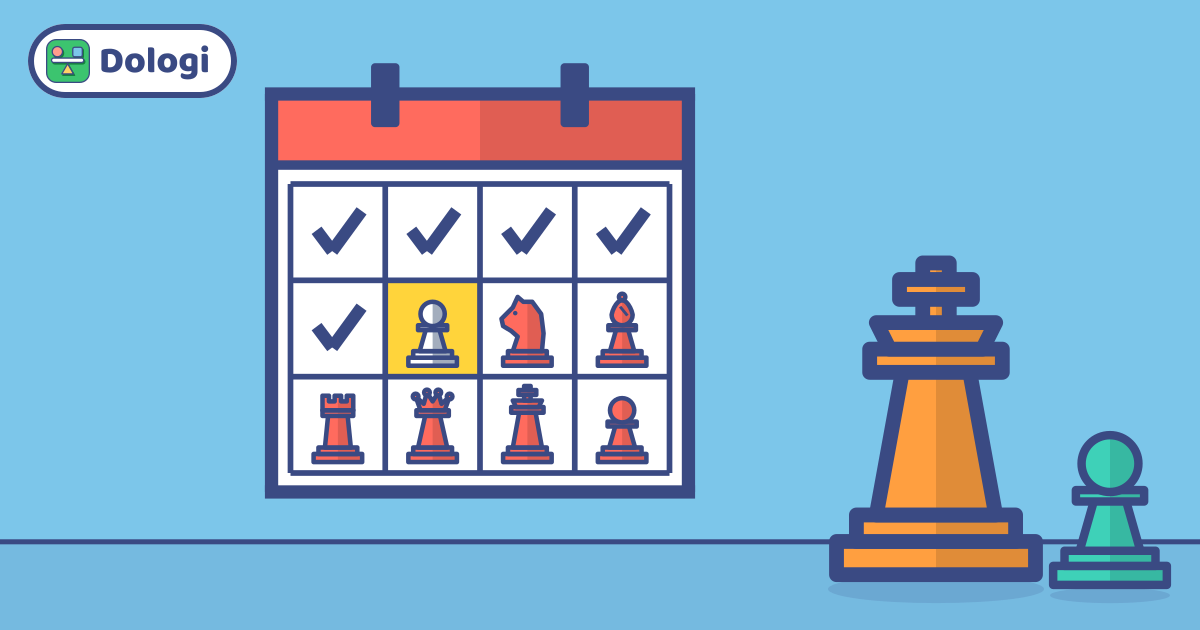
Your child wants to learn chess. You're not ready to sign up for a class, and maybe you don't play much yourself. The first question is usually: where do we start, what do we cover each week, and how long until my kid can play a real game? Picking things up at random tends to leave gaps in the rules, while explaining every rule in one sitting is a fast way to lose a 7-year-old.
Here's a 12-week plan for kids roughly 6 to 10, learning at home with a parent. Each week has one main idea, one game to practice it, and one sign that your child is ready for the next week. Treat it as a guide, not a curriculum. If your child is quick, combine weeks. If they need longer, stay put. Both are fine.
Before you start: short, regular and fun
- Three or four sessions a week, 15 to 20 minutes each. Regular short sessions beat one long weekend lesson. A 6-year-old may only last 10 minutes, and that's okay.
- Three parts per session: a quick review of last week, a few minutes on something new, then play. Try to end every session with a game, not a lecture.
- Board and pieces: a real set is best. If you don't have one yet, draw a board on paper and use bottle caps. Keep a handful of dried beans or pennies around as "stars" for the capture games.
- Learn alongside your child: you don't need to be good first, just a week ahead. Parents who don't play chess has tips for learning together.
Kids of 4 or 5 don't need this plan yet; chessboard games for 4 and 5 year olds are plenty. Kids of 10 to 12 often move faster and may finish in six or seven weeks.
The 12 weeks at a glance
| Week | What to learn | Game to practice | Ready to move on when |
|---|---|---|---|
| 1 | The board: rows, columns, diagonals; rook and bishop | One piece captures all the beans | Your child moves the rook and bishop correctly without reminders |
| 2 | Queen and king | Walk the king across the board, avoiding the rook's squares | Your child can say which squares the king can't enter |
| 3 | Knight and pawn | Knight bean hunt; pawn war | The knight jumps correctly and pawns capture diagonally |
| 4 | Setting up the board; piece values | Games with pawns plus one or two pieces | Your child sets up alone and knows which pieces are worth more |
| 5 | Check and the three ways out | "How do you get out of check?" | Your child finds all three: move, block, capture |
| 6 | Checkmate and stalemate; promotion, castling, en passant | Mate-in-one puzzles | Your child can tell checkmate from stalemate |
| 7 | Three opening principles | First full game | Knights and bishops come out early, king castles |
| 8 | A safety check before every move | Two or three games, pausing before each move | Fewer pieces left hanging for free |
| 9 | The fork (double attack) | Find-the-fork puzzles | Your child spots a knight attacking two pieces |
| 10 | Pins and skewers | Puzzles, then play | Your child notices a pinned piece |
| 11 | Checkmate with king and queen | You keep the lone king, your child mates | Mate without stalemating |
| 12 | Reviewing a game | A "graduation game," then look back at it | Your child points out a move they'd change |
Weeks 1–4: one piece at a time, plus mini games
No full games yet. Each week covers a piece or two, taught through games on a nearly empty board.
- Week 1: show rows, columns and diagonals. Scatter five or six beans and put a rook down: how many moves to capture them all? Repeat with a bishop and let your child discover that it never reaches a square of the other color.
- Week 2: the queen is a rook and a bishop rolled into one, so it's quick to learn. The king moves one square and can't step into a square under attack. Game: you place one rook; your child walks the king from the bottom row to the top without stepping on a square the rook controls.
- Week 3: the knight jumps in an L and can hop over pieces. Pawns move straight, capture diagonally, and may move two squares on their first move. Play "pawn war": eight pawns each on their starting rows, and whoever gets a pawn to the far side first wins.
- Week 4: set up the board (light square in the bottom-right corner, queen on her own color). Introduce the usual point values: pawn 1, knight and bishop 3, rook 5, queen 9. Play small games: eight pawns each plus one piece, then two.
If your child likes short games, a 5 × 5 or 6 × 6 board from mini chess fits this stage well.
Weeks 5–8: the rules for a full game, and how to start one
- Week 5: a king under attack is in check and must get out right away: move the king, block the line, or capture the attacker. Set up a few positions and ask, "How do you get out of check?" Look for all three answers when they exist.
- Week 6: in check with no way out is checkmate. Not in check but no legal move is stalemate, a draw, and plenty of kids find that rule strange, so show a few examples. Also this week: the three special rules, one per session. Check, checkmate and stalemate explained and castling, en passant and promotion explained walk through each one.
- Week 7: the first full game, with three principles: push a center pawn, bring out knights and bishops first, castle early. See chess opening principles for kids.
- Week 8: practice pausing before every move to ask: can the piece I'm moving be captured? What was my opponent's last move trying to do? Play slowly and say your own questions out loud so your child can copy the habit.
Weeks 9–12: tactics, the endgame and looking back
- Week 9: the fork, one piece attacking two at once. Knights are especially good at it. Solve a few positions each session, then play and go "fork hunting."
- Week 10: the pin (a piece can't move because something more valuable sits behind it) and the skewer (a valuable piece is attacked, and when it steps aside, the piece behind it falls). Fork, pin and skewer for kids has positions you can set up.
- Week 11: checkmate with king and queen against a lone king. You take the black king; your child herds it to the edge. The classic trap is stalemating by accident, and king and queen checkmate for kids shows how to avoid it.
- Week 12: play a "graduation game," jot down a few key moves, then go back over it together: which move are you proud of, which one would you take back? For ways to ask without criticizing, see reviewing chess games with your child.
When your child is ahead of or behind the plan
- Slower: stay on that week and swap in a different game to keep it fresh. The last column of the table matters more than the week number.
- Faster: combine weeks, but don't skip week 8. Checking before every move is what changes a beginner's games the most.
- Losing interest: go back to mini games and spend a week learning nothing new. Chess is a game before it's a subject.
- After week 12: play regularly, solve a few puzzles a week, review a game now and then. This is a good time to decide whether a class or club makes sense.
In the Chess room in Dologi's Creative corner, Learn chess follows nearly the same order: 7 Piece by piece lessons (rook, bishop, queen, king, knight, pawn, the whole team) and 16 Topic by topic lessons, from piece values, check and the three ways out of check to the double attack, the pin and mate with queen and king. Each lesson goes watch, try, practice, then play, and every lesson is open from the start, so your child can repeat one or jump to the one they need.
In short
- Twelve weeks in three stages: pieces and mini games, the rules and openings, then tactics, the endgame and reviewing games.
- Three or four short sessions a week, each ending with a game.
- Move on when your child shows the week's sign, not when seven days are up.
- Don't skip the week on checking before every move; being faster or slower than the plan is fine.
Read more: Chess for kids: what age to start and what they actually learn, 10 easy chess puzzles for kids